Feeds:
Posts
Comments

Archive for the ‘native plants’ Category

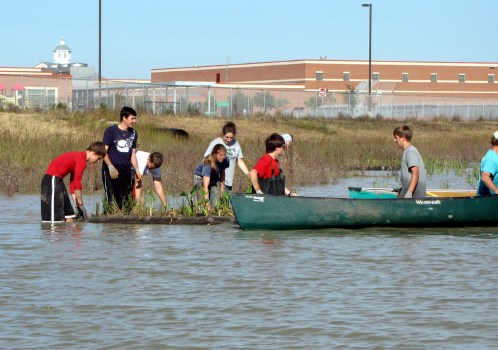
smFloating Wetlands-HBrown (40)
Students and volunteers launch a floating wetland island into the stormwater detention basin. Photo: Helle Brown

Our first installation of floating wetland islands went into the campus stormwater detention pond at Clear Creek Independent School District’s Education Village in League City. TCWP and the school community launched three islands on November 10

When 72 volunteers, 2 camera crews, and the school superintendent show up to help us undertake something new, it sure is wonderful when it is accomplished with hardly a hitch!

(more…)

Read Full Post »

We are moving closer to installing floating wetland islands in what may be the first such project at a school in Texas, and one of the first public installations anywhere in the state. The floating wetlands will be in the storm water detention basin (aka “the pond”) of the Education Village campus in League City TX, part of the Clear Creek Independent School District (CCISD).

islands composite

Left: Floating wetland islands in Canada. Source: Biohavens International. Right: A pilot project in Baltimore Harbor. Source: Waterfront Partnership of Baltimore.

What is a floating wetland? It’s a small buoyant man-made island that grows wetland plants. CCISD’s islands will be made of a dense mesh of recycled plastic fibers produced by Martin Ecosystems. These floating wetlands have plant, soil and root interactions similar to a natural wetland and provide surfaces for colonies of beneficial water-cleaning microorganisms. (more…)

Read Full Post »

Heron-small

A Yellow-crowned Night Heron stalks the new wetland on the grounds of the Johnson Space Center.

Visiting the Johnson Space Center (JSC), you probably anticipate a vision of a high tech future in space.  But to address a more down-to-earth aspect of the space center’s operation, Chris LaChance and I were invited to NASA by Sandy Parker of the JSC Environmental Office to consult on transforming a landscape problem area from boggy lawn to JSC’s first created wetland.

The JSC landscape maintenance contractor, Prodyn EPES, needed a way to deal with the water that pooled in a low spot between a weather station building, parking lots, and a jogging trail. It tended to be too wet to mow, so something else had to be done—and done on a tight budget. At about 2200 square feet, it was too large to be economically practical as a rain garden, which can sometimes require considerable excavation, an underdrain, porous soils, and a selection of predominantly nursery-raised native plants. Chris thought the site had more potential as a created wetland, so she brought me along on the mission.

(more…)

Read Full Post »
Image

Milkweed is the host plant for the Monarch butterfly.

Author Robert Brault writes, “Why try to explain miracles to your kids, when you can just have them plant a garden?” Young children have an innate curiosity and are masters at observation. Encouraged at an early age, they can carry these observation skills throughout their school years and beyond. Attitudes about the environment are formed early, so we should create spaces right outside their doorstep where children can learn to appreciate the wonders found in nature.

Last Child in the Woods, by Richard Louv, struck a chord that still reverberates, making us realize that our future environmental stewards spend too much time in front of video screens during their formative years. This is the time when making connections with nature can ignite a passion that lasts a lifetime. Opening the door to nature can be as easy as walking across the threshold, whether to a large backyard, a small corner of the front yard, or even a balcony. (more…)

Read Full Post »

ImageImage

“There are two ways to face the rainless weeks. One is to water, and the other is merely not to.” Elizabeth Lawrence, a Southern gardener.

Perhaps this is a bit too simplified, but we do have to face the fact that in a world of overburdened water supplies and weather extremes, conserving water in the landscape whenever and however we can has never been more critical. During July, August, and September, Texans’ increase their water use by as much as 58%, with half of what is used to irrigate landscapes being wasted due to over-watering or runoff. The projection for the Houston area is that the population will double by the year 2030, but our water supplies are finite leading us to realize that even though we may get all the rain we need, more people means water shortages–frog-strangling deluges or not.  (more…)

Read Full Post »

« Newer Posts - Older Posts »