Houston needs a comprehensive vision of where it wants to go:

An example of floodplain tailgating?
As I drove into work this morning I found myself behind an 18-wheeler. I was keeping the required distance—one car length for every 10mph, more or less, when the truck swerved just a wee bit, getting pretty close to the concrete divider of the inside lane we were traveling in. Continue Reading »
Posted in flooding, Resilience | Tagged 100-year floodplain, flooding, floodplain, Houston, Tax Day Flood | Leave a Comment »
The Guardian reports on a just-published paper in the scientific journal Nature. The new data suggest sea level rise could be twice that predicted for the next century–2 meters instead of 1. Doesnt sound like much? Think again. This means that development going in today at 20 feet above sea level, in 100 years, maybe less, will be at 14 ft elevation. A very large change when you think about storm tides from just moderate storms. 20ft is low, but it would take a pretty big storm to cause major inundation at that elevation. But 12-14 feet is a whole ‘nother story!
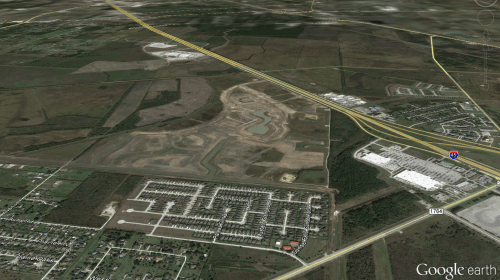
See the photo below, from Google Earth, of new development going in at about 20-25 ft elevation along I-45, just where the Lowry expressway takes off. Probably not much thought about sea level rise went into this project. How would buyers react if they knew how things might change. Well, mortgages only go for 30 years, and most people stay in a house for only about 5 or so. So maybe the developer is making a good bet.
But what about the dikes and levees being proposed for storm surge protection? These dikes will be built for today’s conditions. Unlike houses, dikes are a very serious investment, and we should expect a working dike well past 100 years. Are dikes the most logical investment for our future?
There is a lot of clamoring for our area TO DO SOMETHING! BEFORE THE BIG ONE HITS! And it is all about structural solutions. What about planning? Are we building in the right kinds of places? Are we building the right kinds of places–places we really do want to defend, and that might be worth building tough enough to weather the storms? We need to expand the conversation. Sea level is expanding it for us where we like it or not!
Posted in Uncategorized | 1 Comment »
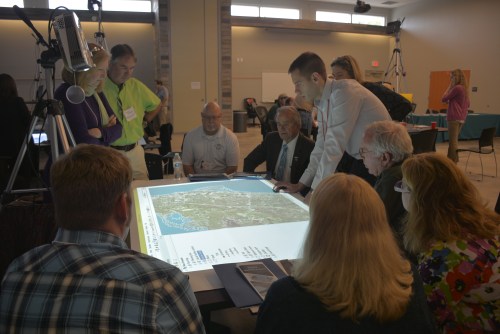
On 3/23/2016 and 3/24/2016, TCWP hosted two resiliency workshops for Aransas and San Patricio Counties. These workshops served as a forum for local officials, staff, and stakeholders to discuss how their communities can grow in a way that reduces the risk of flooding and future disasters.
Over 60 people participated in these workshops and interacted with representatives from Texas A&M, FEMA, the Texas Department of Insurance, the US Army Corps of Engineers, and the Texas Department of Emergency Management.
In addition to learning about hazard mitigation and what these agencies are doing to promote resiliency, participants used TCWP’s CHARM mapping platform to analyze the impact that different development scenarios would have on future water infrastructure demand, flood risk, storm surge risk, etc.
The Resiliency Workshops were coordinated by TCWP’s CERC team. TCWP will host a resiliency workshop for each Texas Coastal County during 2016/2017.
For more information about how you can become involved, please contact Resiliency Program Coordinator Race Hodges at race.hodges@tamu.edu
Posted in Resilience, Uncategorized | Leave a Comment »
New Article Available!
Communities have many ways to guide future development to minimize hazard vulnerability – building codes, comprehensive plans, zoning regulations, etc., however, the degree to which different local plans and policies support one another in reducing risk often varies greatly.
In the recently published Evaluation of Networks of Plans and Vulnerability to Hazards and Climate Change, Berke et al. (2015) present their development of a resiliency scorecard which can be used to assess how well local plans are integrated and if they reduce, or perhaps inadvertently increase, long term physical and social vulnerability to hazards.
The article references a number of studies which indicate that hazard mitigation planning, centered on strong land use practices, is extraordinarily more effective in reducing the impacts of hazards than reactive emergency response.
This paradigm shift in emergency management has required that long term community planning play a critical role in the disaster resilient community, however, this requires that various municipal officials, such as those involved with public works, urban planning, emergency management, etc., are aware of how they can work together to ensure that their community’s plans, policies, and practices are well integrated to reduce disaster vulnerability. Continue Reading »
Posted in Resilience | 1 Comment »
-
Authors
This blog does not represent official policy of the Texas A&M University System. Each post is grounded in science, but also reflects the passion of each of the staff members of the Texas Community Watershed Partners staff.
-
Recent Posts
Archives
- May 2019
- December 2018
- September 2018
- July 2018
- May 2018
- March 2018
- January 2018
- December 2017
- November 2017
- October 2017
- September 2017
- August 2017
- July 2017
- June 2017
- May 2017
- April 2017
- March 2017
- February 2017
- January 2017
- December 2016
- November 2016
- October 2016
- September 2016
- August 2016
- July 2016
- June 2016
- May 2016
- April 2016
- November 2015
- September 2015
- July 2015
- May 2015
- March 2015
- February 2015
- December 2014
- November 2014
- September 2014
- July 2014
- June 2014
- April 2014
- March 2014
- February 2014
- January 2014
- December 2013
- November 2013
- October 2013
- September 2013
- August 2013
- July 2013
- June 2013
- February 2013
- January 2013
- September 2012
- July 2012
- June 2012
Categories
- Bay-friendly
- children in nature
- coastal prairies
- drought
- environmentally friendly landscaping
- flooding
- founding gardeners
- freshwater inflows
- Galveston Bay
- Green Stormwater Infrastructure
- Harvey
- Hurricane
- native plants
- planning
- rain garden
- Resilience
- retoration
- runoff pollution
- science
- stormwater
- stormwater wetlands
- The Wetland Restoration Team
- Uncategorized
- urban
- Walkability
- watersmart
- WaterSmart Landscapes
- wetland restoration
Tags
American independence appellation bacteria bay bayous children and conservation children in nature compost conservation courses curb appeal development Dickinson Bayou drought Exploration Green floating wetlands flooding floodplain floodplain development floodplain management Frederick Law Olmsted front yard gardens galveston Galveston Bay gardening with kids Girl Scouts Harvey Houston Hurricane lawn reduction map mulch NASA native plants outdoor classroom oyster parks Pearland placemaking planning prairie rain gardens reef resilience restoration Richard Louv runoff schools septic system Sheldon Lake State Park stormwater management stormwater wetlands students tasting terroir Texas history texas master naturalist Tommy's trails transity transportation video volunteers walkability walkable water conservation water quality watersheds Wetland nursery wetland plants wetland restoration Wetland Restoration Team wetlands wildlife wildlife habitats
 Steven Mikulencak
 Charriss York
 Watershed Texas