Feeds:
Posts
Comments

Image

Last week, our normal Friday crew ventured out to the Phase 4 forested wetlands—the farthest east you can travel and still be on the park.  The intent of this scouting trip was to note the sizes and extent of Chinese tallow trees in the wetland basins.  As expected the basins were full of tallow and, fortunately, of a size (e.g. not too big) consumable by the mulching machines.   Our restoration plan for 2014 includes hiring a contractor to remove the Chinese tallow without harming the existing stands of sweet gum, pine, cypress and very old yaupons.   For the majority of the work, access to the areas with heavy tallow stands is easy and will not require much maneuvering (and by extension, minimal damage).  We were pleased with what we saw in the forest for the prospective clearing job.

It was, however, hard to drag park ranger Kelly out of the forest—being the East Texas boy he is.  But as we stomped our way out of the forest we passed some old sweet gum trees, and I made it very clear that I am a city girl. (Yikes!) One of the larger tree trunks was laced with a series of holes.  Pointing to the holes in the truck, I turned to Kelly, who replied with one word, “sapsucker”.   Cullen chimed in, “probably yellow-bellied sapsuckers, based on the region”.  It was a ‘duh’ moment for me, as I have seen sapsuckers on the park, but it has been a while only because my time at Sheldon Lake State Park is mostly spent in the wetlands on the prairie.

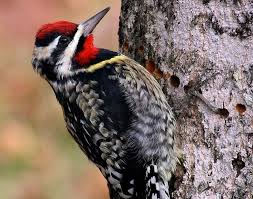
Image  sapsucker

Sapsuckers are a small woodpecker, and it makes sense that they would leave evidence of their presence behind them on the tree they “harvest”.  The holes were deep and in consistent rows which made me appreciate the industry and effort of this little bird.  It is one thing to know that the sapsucker will drill 10 holes in wood and another thing to see the holes and the effort it takes to drill through the hardwood to get to the sap.

Well, little sapsucker, we hope to clean up your neighborhood by taking out the trash trees.  Maybe by clearing out the tallow, we will give the standing sweet gum, pine and cypress more of a chance to make sap for your little hungry belly.

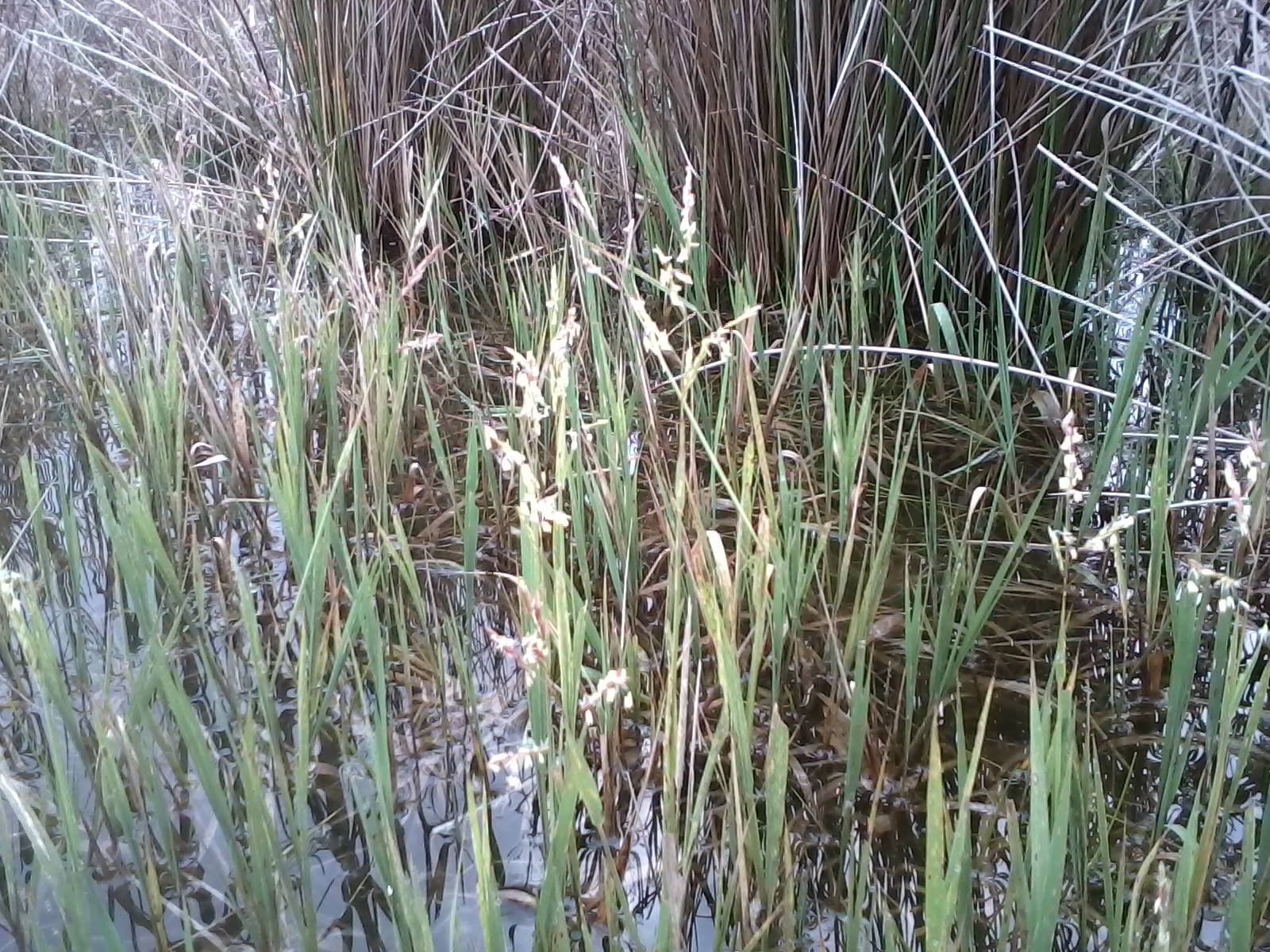
During any or all of our vegetation monitoring cycles, I always look for something new in the ponds.  Mostly, I do this because it is not a given that I will get a complete picture of the plant community in any of the “transect” points.  So, it behooves me to look around at the surrounding areas when we are tallying up each sample plot.  This last cycle reminded me of the blessed nature of natural “recruits”—in this case, Leersia hexandra or commonly called:  southern cutgrass.

Image

All the lovely short green stuff in the foreground is Southern cutgrass.

Image

The seedhead on the Leersia hexandra plant is a good giveaway as to its identity.

Phase 1 was my first introduction to the colonization potential of Leersia.  We never planted a single sprig of Leersia in  these ponds—well, never intentionally planted.  It came in with other wetland plants and proceeded to stake out its zone—the 0-3” range.  At these shallow depths, the single surviving transplants eventually multiplied and established a clear zone of vegetation.  What made this more remarkable was that the establishment of this hardy native meant the aggressive exotics (e.g. Deep rooted sedge) were thwarted.  (Get ‘er done, Leersia!!!)

Needless to say, after observing this community dynamic, I incorporated Leersia actively into Phase 2 and 3 of the wetland restoration at Sheldon Lake SP.  And will continue to use it (and its cousins like Panicum dichotoflorum) in future phases of the project and other similar projects. But for now, I was happy to see it proliferating on the inside edge of pond 11.

Possumhaw Holly

Possumhaw Holly

Once the holiday season is over and we experience cooler temperatures along with occasional rain begin, most of us put thoughts of landscaping into a kind of suspended animation. Much of what is referred to as “color” in the landscape has left our gardens to be replaced by colors of the extended holiday season that begins with Halloween and ends with New Year’s Day. After all, isn’t this the time of year when plants are supposed to go dormant—losing leaves, going to seed, or disappearing altogether until the warmth of the spring sun brings them to life again? Continue Reading »

Green roofs are popping up all around the country.  The benefits of these roof top gardens are widely recognized: turning an impervious surface into a pervious one; reducing energy costs; improving air quality; reducing the urban heat island effect; the list goes on.  Despite the need for additional engineering work and sometimes added upfront building costs, this best management practice is really catching on.  Cities like Chicago have hundreds of green roofs, and even small communities like Webster and Friendswood Texas can brag about a green roof in their town.

As the idea of roof top gardens spreads, new ideas continue to pop up.  One of the coolest in my opinion is making the roof top into an actual garden; an edible garden; growing food on your roof.

All of the folks that I can find who have created roof top vegetable gardens are using commercial spaces or multi-family dwellings.  Mostly because they are larger, typically have flat roofs and more accessible.  They also offer opportunities for gardening in urban areas where real estate is at a premium and on the ground space is difficult to come by, it’s the idea of growing up, not out, applied to gardens.

Click on the photos below to check out some  projects where roofs are producing food and improving water quality, not just keeping us warm and dry.

  HigherGroundFarm Higher Ground Farm boasts of being Boston’s first rooftop farm

BRITrooftopCactus

The Botanical Research Institute of Texas has a more traditional green roof but harvested prickly pear fruit to make jelly

EagleStreetRooftopFarm

Eagle Street Rooftop Farm in Brooklyn

RoyalYorkRooftopGarden

Royal York Hotel Rooftop Garden in Toronto has taken the local food movement to heart

CupSaucerWetlands1

A scene from Cup and Saucer wetlands in Canterbury, NSW, Australia. Source: Sydney Water

Many of us are visual learners, and video-sharing sites like YouTube come to the rescue when we want to gain an understanding of something new and uncommon. That goes for learning about stormwater wetlands too—although good videos portraying them are few and far between. Stormwater wetlands don’t do hilarious tricks or say cute things, and at least for now, they aren’t abundant subjects for filming. However, the key to familiarizing people with their benefits—water quality improvements, habitat, and flood control, among others—is having good examples to which we can refer. Until there are ample stormwater wetland demonstration projects in the Galveston Bay Area, we can rely on “distance learning” through articles, photos, and now, video.

I had a look and curated a few videos to give you the idea of how a stormwater wetland appears.

Continue Reading »