Feeds:
Posts
Comments

0815130934-01 DSCN0005

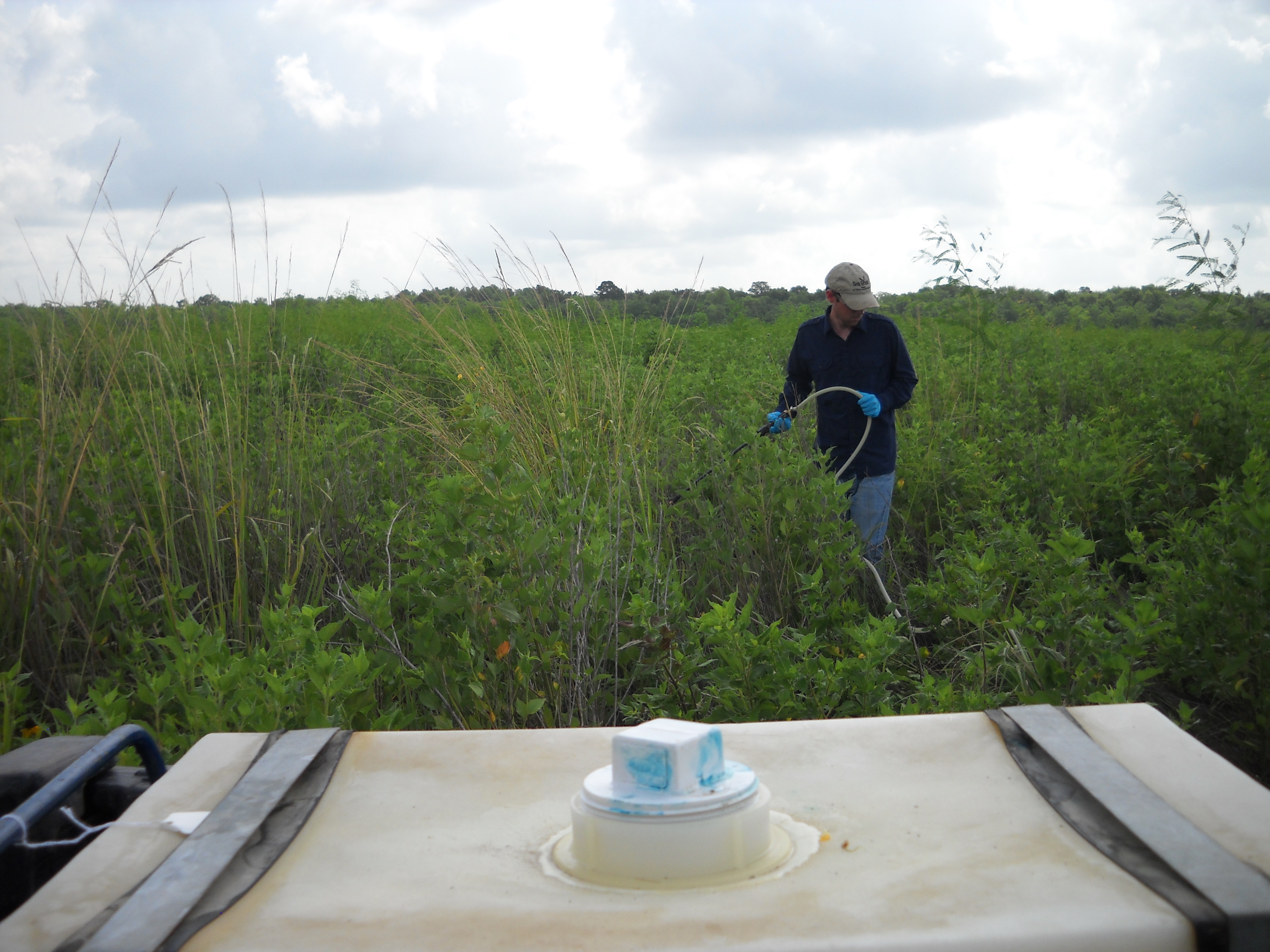
During my junior year Field Biology course at the University, I had my first introduction to a basic tenet: field biology isn’t always pretty (or comfortable or clean or fun) but it will always have a purpose.  Each friday this summer, I am reminded of that tenet, and smile under rumpled straw hat, now partially colored from marker dye.

We (Cullen, myself, willing Team members and Kelly, the Park Natural Resource Ranger) have made a commitment to treating vaseygrass in the restoration areas. While I never expected to be pleased by something dying, I find myself feeling vindicated and pleased by our eradication efforts.  Vasey Grass or vaseygrass, Paspalum urvillei (http://www.texasinvasives.org/) is a South American perennial grass which was accidentally introduced near New Orleans in 1883 per the USDA 1925 Farmers Bulletin (http://digital.library.unt.edu/ark:/67531/metadc1769/m1/26/). At that time, Vasey grass was considered an important secondary forage species in pastureland partially because it had spread and established well in the region, and it has a remarkable “ability to grow in wet land and survive severe drought.”  However, now this noxious bunch grass presents a serious threat to pastures and conservation lands alike, as evidenced by studies identifying appropriate management techniques to control vaseygrass (https://www.crops.org/publications/cs/abstracts/45/5/2038).

For all the reasons cited above, we have made our summer mission to eradicate what we can of this weed—given that the wetlands are dry and we can easily access all areas. To date, we have completed our treatment for all 48 acres of Phase 3, and we are currently planning our “attack” of Phase 2.  So, when the straps of the backpack sprayers bite into my shoulders, I remember that the work is what matters and keep going.  We have more acres (over 70) left to treat and thankfully we have a new 45-gallon sprayer tank fitted with two nozzles to assist our mission. I personally am looking forward to the continued eradication and am equally hopeful of its success.

(The pictures above are of Cullen Ondracek, giving the vaseygrass the evil eye during a reconn, and on a different day, spraying with herbicide)

References:
U.S. Department of Agriculture. (1925). Farmers Bulletin 1433: “Cultivated grasses of Secondary Importance”. Washington DC. U.S. Department of Agriculutre. (pg: 22-26).

Newman, Y.C. and L. E. Sollenberger. (2005) “Grazing Management and Nitrogen fertilization effects on Vaseygrass persistence in limpograss pasturelands.” Crop Science, 45(5), 2038-2043.

Heron-small

A Yellow-crowned Night Heron stalks the new wetland on the grounds of the Johnson Space Center.

Visiting the Johnson Space Center (JSC), you probably anticipate a vision of a high tech future in space.  But to address a more down-to-earth aspect of the space center’s operation, Chris LaChance and I were invited to NASA by Sandy Parker of the JSC Environmental Office to consult on transforming a landscape problem area from boggy lawn to JSC’s first created wetland.

The JSC landscape maintenance contractor, Prodyn EPES, needed a way to deal with the water that pooled in a low spot between a weather station building, parking lots, and a jogging trail. It tended to be too wet to mow, so something else had to be done—and done on a tight budget. At about 2200 square feet, it was too large to be economically practical as a rain garden, which can sometimes require considerable excavation, an underdrain, porous soils, and a selection of predominantly nursery-raised native plants. Chris thought the site had more potential as a created wetland, so she brought me along on the mission.

Continue Reading »

Image

Milkweed is the host plant for the Monarch butterfly.

Author Robert Brault writes, “Why try to explain miracles to your kids, when you can just have them plant a garden?” Young children have an innate curiosity and are masters at observation. Encouraged at an early age, they can carry these observation skills throughout their school years and beyond. Attitudes about the environment are formed early, so we should create spaces right outside their doorstep where children can learn to appreciate the wonders found in nature.

Last Child in the Woods, by Richard Louv, struck a chord that still reverberates, making us realize that our future environmental stewards spend too much time in front of video screens during their formative years. This is the time when making connections with nature can ignite a passion that lasts a lifetime. Opening the door to nature can be as easy as walking across the threshold, whether to a large backyard, a small corner of the front yard, or even a balcony. Continue Reading »

Last month I shared about the connection between septic systems and degraded water quality.  I wanted to follow up with some simple this you should and should not do to keep your septic system in good working order.

Roll

Do!

  • Have your septic tank pumped every 3-5 years
  • Keep a map of where you septic system is located
  • Divert roof drains and surface runoff away from your septic system, excess water can overwhelm your system and cause backups into your home
  •  Use your garbage disposal sparingly, excess solids sit in your tank an increase the frequency of pumping

Continue Reading »

My colleagues at work know that I love to eat oysters. I enjoy them raw, but fried or grilled oysters are tasty too. A light soup made with leeks, cream, stock, and shucked oysters is an all-time favorite and proves the point that simple is often better. But the simplest preparation is oysters on the half-shell, which is perhaps the best way to appreciate how local conditions shape these bivalves. And when I take my seat at the oyster bar, I’m thinking specifically of oyster flavor and texture.

Oysters thrive where fresh and salt water mix, conditions that make Galveston Bay suitable for numerous oyster reefs. The Bay’s shape and in-flowing rivers means that salinity, temperature, depth, and currents change from point to point. These highly localized conditions within the Bay can produce two seemingly different oysters harvested only miles apart. A Pepper Grove Reef oyster from East Bay may taste bright and salty, while the Lone Oak oyster from nearby Trinity bay can have a creamy texture and a briny sweetness. These local conditions also shape the shell’s surface (smooth or ribbed) and the color and tenderness of the plump morsel inside. What this all means is that Galveston Bay produces as many oyster varieties as it has reefs. For foodies and oyster lovers, this is something to celebrate.

Oyster Reef Appellations

Oyster Reef Appellations

Two years ago, I had the opportunity to work in partnership with the Galveston Bay Foundation and Tommy’s Oyster Bar to draft a map illustrating the location of reefs in the Galveston Bay. 
Continue Reading »